

Launching a consumer-packaged good into retail can torch your launch budget fast—one flimsy dieline or off-base claim is all it takes. To surface the best retail packaging design companies for CPG shelf launches, we audited 20 high-ranking resources, scored 10 agencies against seven risk-reduction criteria, and crowned three partners that move products from concept to shelf with fewer do-overs. In the pages ahead, you’ll see how those agencies stack up, what each option costs, and which 2027 regulations should shape every prototype.
Research snapshot: September 1, 2026.
The three best CPG packaging partners at a glance
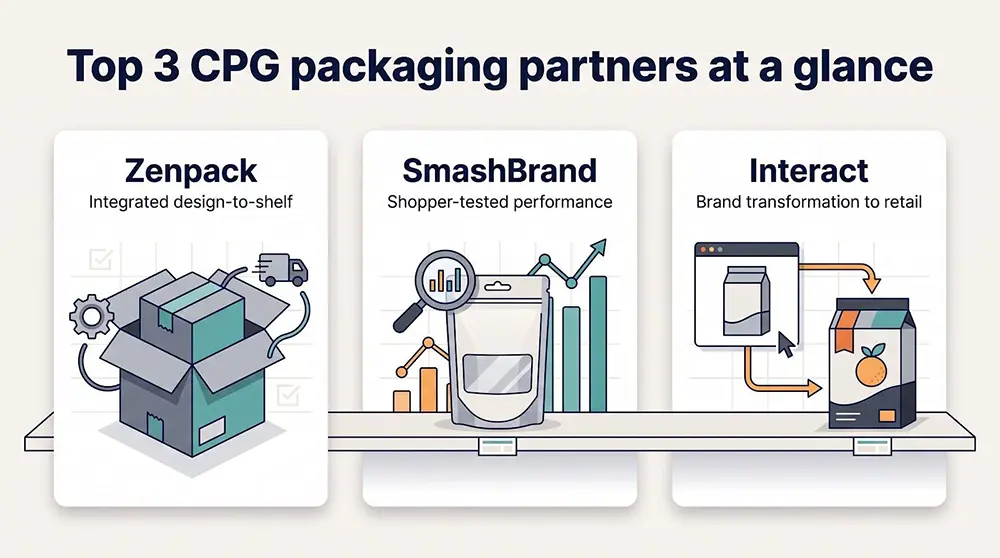
You said you need partners who cut launch risk – not another mood-board studio. After benchmarking ten firms against seven execution criteria, three stood out for different reasons.
Think of them as three distinct operating models, not one-size-fits-all choices.
- Zenpack handles the full journey from concept through manufacturing and logistics.
- SmashBrand stress-tests every design with shoppers until the data says “buy.”
- Interact translates buzzy DTC identities into retail packs shoppers can decode in seconds.
| Agency | Best when you need… | Public budget signal* | Typical timeline* | Key trade-off |
|---|---|---|---|---|
| Zenpack | Single accountable partner for design, engineering, and production | Structural work from $8k; prototypes from $500 | Design 8–12 weeks; sampling 4–8 weeks | Confirm MOQ wording and overseas lead time |
| SmashBrand | Quant-proven packaging that wins head-to-head tests | $25k–$500k full program | 2–5 months door-to-door | No in-house manufacturing, so handoffs matter |
| Interact | A brand refresh that jumps from online cart to retail shelf | Quote required | Quote required | Limited public cost/timing data – ask early |
Figures come from agency websites or case materials and should be re-verified during your RFP.
Keep reading to see why each shop earned its spot, where it shines, and when you should keep looking.
How we evaluated the companies
We built a scorecard to measure what can sink or save a CPG shelf launch. Each agency earned a raw 1–5 score across seven areas, then we applied weights based on financial risk.
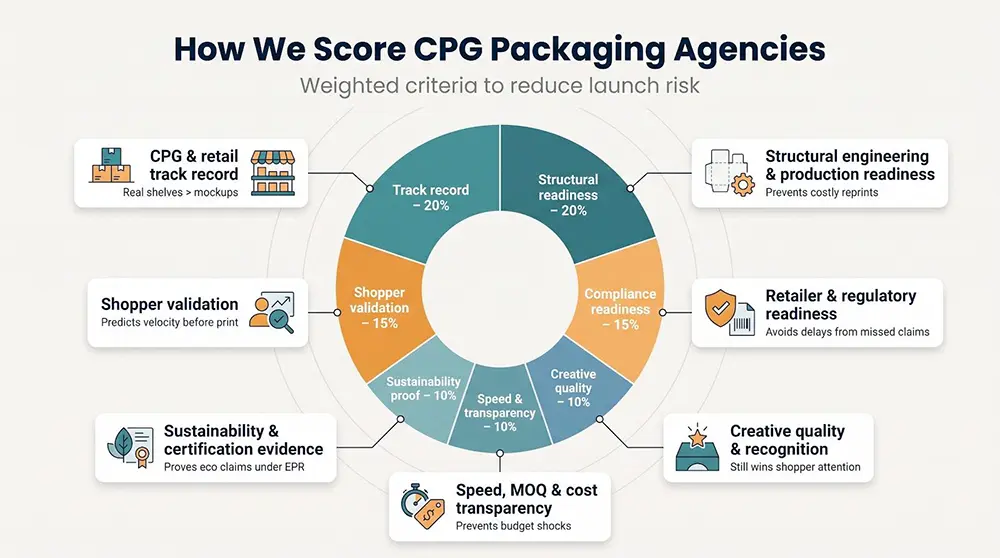
| Criterion | Weight | Why it matters in a shelf launch |
|---|---|---|
| CPG & retail track record | 20% | Real shelves > portfolio mock-ups |
| Shopper validation (lab, eye-tracking, intent) | 15% | Predicts velocity before you print plates |
| Structural engineering & production readiness | 20% | A perfect dieline is non-negotiable |
| Retailer & regulatory readiness | 15% | Missed claims or barcodes delay launches |
| Sustainability & certification evidence | 10% | EPR fees and retailer scorecards demand proof |
| Speed, MOQ & cost transparency | 10% | Surprises here blow up budgets late |
| Creative quality & recognition | 10% | Distinctive design still drives attention |
The weighting rewards agencies that prevent costly reprints and compliance missteps without ignoring memorable creativity. Scores reflect public evidence as of September 1, 2026; re-check them with current case data during your RFP.
Our seven scoring criteria
A slick portfolio can hide launch risk, so we graded each agency on seven pressure points that decide whether a package survives the shelf gauntlet.
| Criterion | Why it matters | Weight |
|---|---|---|
| CPG & retail track record | Real, printed packages on real shelves beat mock-ups every time | 20% |
| Shopper validation | Lab tests, eye-tracking, and purchase-intent data predict velocity before you print plates | 15% |
| Structural engineering & production readiness | Printers need press-ready dielines, not creative hypotheticals | 20% |
| Retailer & regulatory readiness | From Walmart shelf tags to FDA label rules, compliance keeps launches on schedule | 15% |
| Sustainability & certification evidence | FSC numbers, ISTA reports, and ISO certificates back up eco claims | 10% |
| Speed, MOQ & cost transparency | Clear timing and unit economics prevent last-minute budget shocks | 10% |
| Creative quality & recognition | Distinctive design still drives attention, just not at the expense of logistics | 10% |
Weights mirror the financial risk each factor controls: structural and retail readiness outrank pure aesthetics, but creative distinctiveness still counts.
1. Zenpack – best for integrated design-to-shelf execution
Imagine one partner sketching a dieline at 9 am, cutting a white prototype that afternoon, and booking freight once you approve the golden sample. That integrated model places Zenpack’s custom packaging design work at the top of our list.
Zenpack pairs brand designers with packaging engineers under one roof, backed by an ISO-audited production network and an ISTA-certified test lab. Fewer hand-offs create a single point of accountability when retailer deadlines tighten.
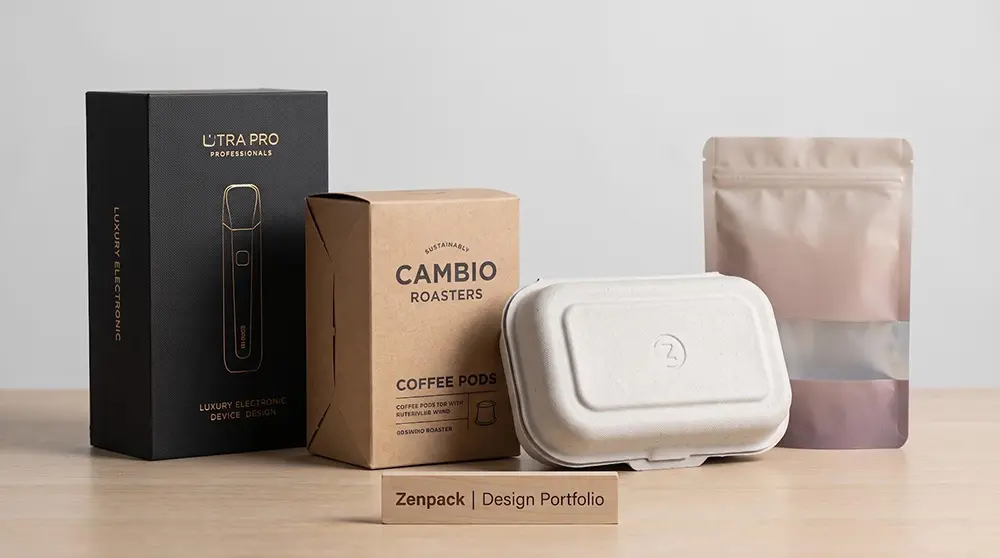
Zenpack custom packaging design service website screenshot
Key public numbers worth bookmarking
- Structural projects start around $8,000; prototype samples from $500
- A typical design phase runs 8–12 weeks, followed by 4–8 weeks of sampling
- The company lists no absolute MOQ, though most jobs become economical near 5,000 units
Awards prove speed to sample: Zenpack’s paper-only Dwell Dripper package earned 2025 DIELINE gold for protecting a silicone brewer while assembling in seconds. A VSSL refresh turned a DTC box into an open-window retail pack that survived transport and sparked social buzz.
Sustainability data is equally concrete, including FSC chain-of-custody options and ISO 9001 and ISO 14001 manufacturing partners. The in-house lab can run drop, vibration, and climate tests before you invest in tooling.
Watch-outs
- Core manufacturing happens overseas, so factor freight, customs, and possible port delays into timing.
- MOQ language varies by page; lock quantity and pricing in writing before approving dielines.
Choose Zenpack when a missed ship date would sink your launch budget or when you want one team to guide graphics, structure, testing, and production without gaps in ownership.
2. SmashBrand – best for consumer-tested shelf performance
Some agencies rely on instinct; SmashBrand relies on data. Every project moves through its trademarked Path to Performance, a multi-stage research loop that makes concepts win real shopper votes before any printing plate is made.
A public example is the Ollie fresh-pet-food redesign. Across seven studies with 3,300 consumers, SmashBrand produced a 19-point purchase-intent lift. The new pack rolled into every Petco nationwide and surpassed the previous category leader. Case pages pair eye-catching creative with sales or distribution gains, not just trophy photos.
Investment signals are clear: programs start near $25,000 and can reach $500,000 for a portfolio-wide, research-heavy scope. Typical timing is 2–5 months, covering category audit, claims testing, iterative design sprints, and final shelf simulation. A weak package can cost far more in lost velocity.
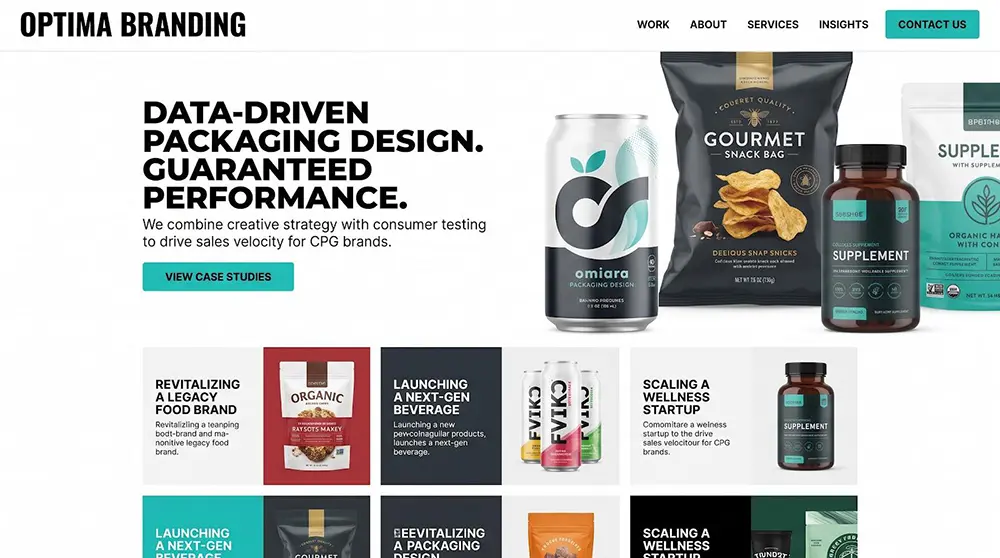
SmashBrand Path to Performance packaging agency website screenshot
Know the limits. SmashBrand refines structure and manages pre-production, but it does not run the presses. You—or your co-packer—still own dielines, color targets, and press checks, so budget extra buffer for converter alignment when timelines are tight.
Choose SmashBrand when stakeholder opinions clash, the aisle is crowded, or a Walmart buyer demands proof that shoppers will reach for your product. Bring clear performance goals and confirm in writing who handles sample recruitment, shelf stimuli, and line-trial coordination, then let the data steer the creative.
3. Interact Brands – best for CPG brand transformation
Many studios stumble when a beloved DTC identity meets crowded retail shelves. Interact Brands makes the leap by keeping online equity intact while rewriting the pack for three-second aisle recognition. Its BUILT protein-bar redesign proves the point: velocity per point of distribution doubled and retail sales tripled within six months.

Interact Brands CPG brand transformation agency website screenshot
Food, beverage, snack, and wellness lines dominate Interact’s roster because those categories live or die by instant flavor, benefit, and brand cues. The team pressure-tests that hierarchy through live shelf simulations, controlled A/B tests, and an in-house AI scan that flags readability gaps before files reach prepress.
Public pricing is scarce, so expect a quote-driven scope that can range from a single flavor extension to a full identity reboot across dozens of SKUs. Use your RFP to confirm who owns structural engineering, retailer compliance, and press-check attendance; clarity here prevents scope creep later.
Choose Interact when you need to protect hard-won brand equity yet win bolder shelf presence. The studio’s system-level approach keeps founder personality intact while delivering clean spec sheets, readable facings, and a smoother path to nationwide rollout.
Full ten-company scorecard
Wondering where the other contenders landed? Below is the raw-score heat map based on the seven criteria and weights outlined earlier. Scores reflect only public evidence available as of September 1, 2026; treat them as a starting point for your own vetting.
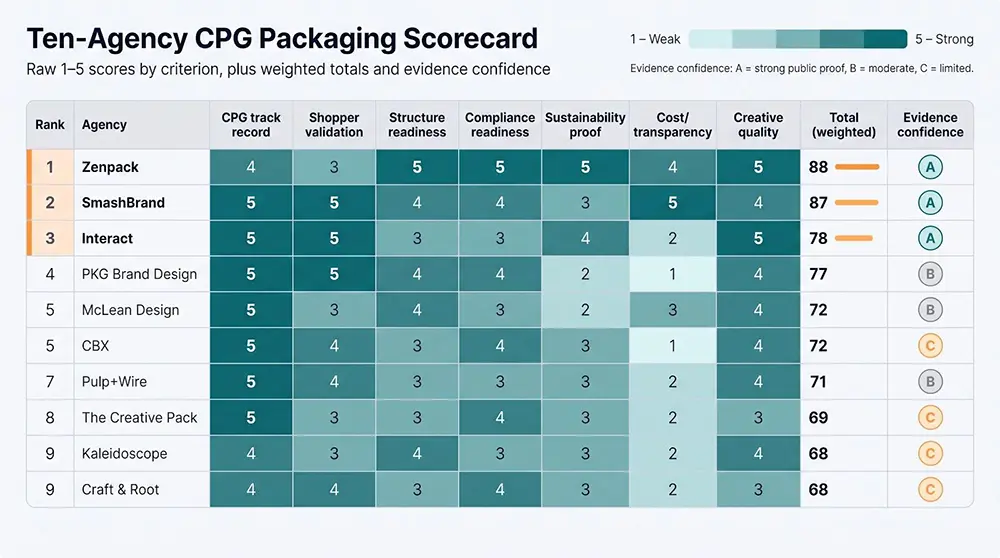
| Rank | Agency | CPG track record | Shopper validation | Structure readiness | Compliance readiness | Sustainability proof | Cost/transparency | Creative quality | Total (weighted) | Evidence confidence |
|---|---|---|---|---|---|---|---|---|---|---|
| 1 | Zenpack | 4 | 3 | 5 | 5 | 5 | 4 | 5 | 88 | A |
| 2 | SmashBrand | 5 | 5 | 4 | 4 | 3 | 5 | 4 | 87 | A |
| 3 | Interact | 5 | 5 | 3 | 3 | 4 | 2 | 5 | 78 | A |
| 4 | PKG Brand Design | 5 | 5 | 4 | 4 | 2 | 1 | 4 | 77 | B |
| 5 | McLean Design | 5 | 3 | 4 | 3 | 2 | 3 | 4 | 72 | B |
| 5 | CBX | 5 | 4 | 3 | 4 | 3 | 1 | 4 | 72 | C |
| 7 | Pulp+Wire | 5 | 4 | 3 | 3 | 3 | 2 | 4 | 71 | B |
| 8 | The Creative Pack | 5 | 3 | 3 | 4 | 3 | 2 | 3 | 69 | C |
| 9 | Kaleidoscope | 4 | 3 | 4 | 3 | 3 | 2 | 4 | 68 | C |
| 9 | Craft & Root | 4 | 4 | 3 | 4 | 3 | 2 | 3 | 68 | C |
How to read this grid:
A lower score can simply mean an agency keeps proof points under NDA. Use these numbers to focus your RFP questions, then update the matrix with fresh evidence before you make a final call.
Honourable mentions worth a second look
Several strong contenders sit just outside the podium, and each shines in a specific launch scenario:
PKG Brand Design. Combines shopper heat-mapping with structural design through its Consumer First process; ideal if you want SmashBrand-level rigor but already have manufacturing locked.
McLean Design. A reliable choice for legacy food and beverage lines that juggle multiple aisles and cannot risk rookie mistakes.
Pulp+Wire. Founder-friendly creative for food, beverage, and lifestyle launches; its Magnolia Bakery retail packs show how café magic can survive the trip to CPG shelves.
CBX. The enterprise pick. Private-label operators and Fortune-500 portfolios rely on CBX for system thinking across hundreds of SKUs, though public pricing and timing data are sparse.
Treat these shops as situational aces. Match their strengths to your brief, ask for current proof points, and one of them could be the perfect fit just beyond our top three.
What a real-world CPG packaging budget looks like
Sticker shock hits hard the first time you price a shelf-ready pack. The fix: break spending into three buckets so you can see where each dollar goes and spot easy trims.
- Strategy & design. Positioning workshops, naming, identity, architecture, and concept passes live here. A single-SKU graphic refresh can cost $10,000–$25,000, while a research-heavy portfolio program can top $100,000.
- Development & validation. Structural engineering, white prototypes, regulatory review, photography, and lab tests move the project from idea to press-ready. Tooling is the wild card; a child-resistant zipper or molded insert can add tens of thousands. Plan on $5,000–$50,000, depending on complexity and how many “one more test” loops you green-light.
- Production & delivery. Unit cost, assembly, freight, duties, warehousing, and retailer prep fees decide the real margin. A gorgeous two-dollar carton is pointless if freight erases a dollar of profit on the trip to a 3PL.
If cash is tight, stage the spend. Start with a semi-custom structure, run a 1,000–3,000-unit pilot, and hold off on custom tooling until sell-through data proves the concept. Challenger brands often commission the full menu so they hit national chains cleanly on the first swing, while enterprise teams routinely budget six figures because a failed launch across 50 SKUs costs far more than diligence up front.
Pro tip for your RFP: ask agencies to quote all three buckets separately. That clarity prevents a low design fee from hiding pricey prototypes, unquoted line trials, or a freight bill that wipes out margin later.
How to choose a packaging design partner
Clicking a glossy directory is easy; signing a six-figure scope that can make or break your launch takes rigor. Tackle it with a structured RFP: ask every bidder the same written questions, then debrief on a live call to confirm the pitch team is the crew you will work with every day.
Ten questions that separate pros from portfolio builders
- Which three packages have you launched in our category during the past two years, and what were the in-market results?
- Who will manage our account daily, and can we meet that person before we sign?
- Do you handle brand strategy, graphics, and structural engineering in-house, or do you outsource parts of the work?
- Who owns the final dielines, tolerances, and press-ready files?
- How do you validate retailer, FDA, USDA, or claims compliance before tooling?
- What shopper-testing methods will you run, and how will those insights direct the creative?
- Which prototypes and physical tests are included in the base quote, and which cost extra?
- Which manufacturing assumptions drive your unit-cost and lead-time estimate?
- What are the pilot, economical, and reorder MOQs, and how do unit costs shift at each break?
- Who owns working files, research data, photography, and unused concepts once the project closes?
Check references next. Ask past clients about surprise freight bills, last-minute dieline changes, or absent account teams after kickoff; a ten-minute call often tells you more than a forty-slide deck.
What “2027-ready” packaging really means
If your next pack will still be on shelf in 2027, bake these five shifts into every brief and prototype.
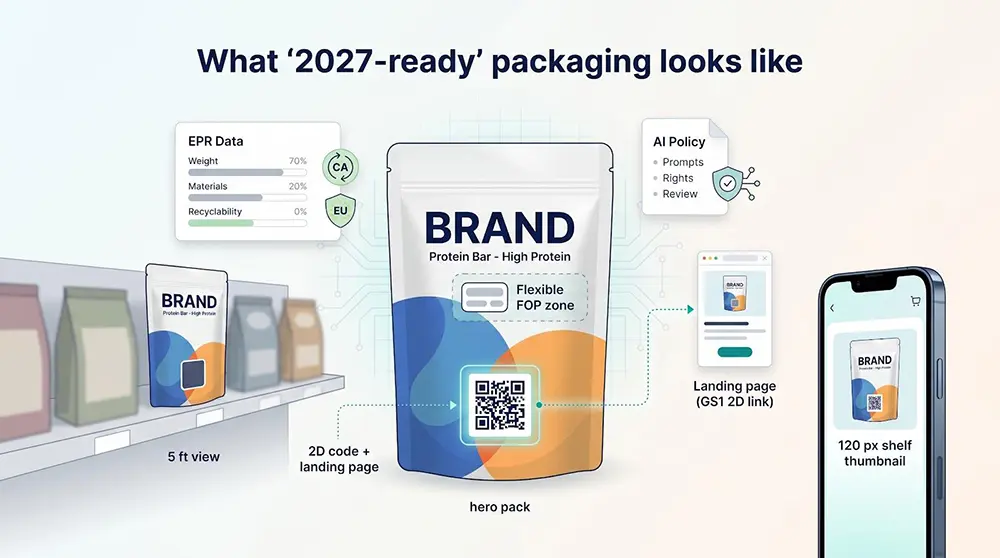
- 2D barcodes become mandatory scanning targets. GS1’s retail industry goal is universal 2D-code readability by December 2027; designers must leave quiet zones and printers must control dot gain, while brand teams own landing-page content.
- Extended producer responsibility (EPR) gets real. California’s SB 54 begins collecting roughly $500 million per year from producers in 2027, and the EU Packaging and Packaging Waste Regulation already applies across Europe. Ask agencies for a sample EPR data sheet covering weight, components, and recyclability.
- Front-of-pack nutrition labels may change. FDA’s proposed FOP symbol is still pending, but history says label rules rarely loosen. Leave flexible space on the primary panel and lock typography so a new box or icon slides in without a full redesign.
- Physical and digital shelves now merge. Test packs at five-foot grocery distance and as a 120-pixel Instacart thumbnail; confirm color profiles for retailer portals that often darken mid-tones.
- AI demands governance, not buzzwords. Ask for an AI policy: prompt logs, rights checks, human review gates, and version control that keeps off-brand art or unlicensed stock out of your files.
Treat these five checkpoints as non-negotiable RFP line items. If a pitch team skips them, expect the headaches to arrive 18 months from now.
From brief to shelf: the real-world workflow
A polished box on the aisle hides a complicated relay behind the scenes. Map these eight milestones on one Gantt chart, and you’ll spot delays before they cost you shelf space.
- Channel brief. Sales gathers retailer specs, operations flags pallet patterns, and marketing locks the benefit hierarchy.
- Category audit. A detailed sweep to see who owns shelf real estate, color cues, and claims language.
- Parallel concepting. Designers sketch visual territories while engineers rough in dielines, materials, and closures; early 3D mock-ups merge both tracks so conflicts surface fast.
- Consumer & shelf testing. Digital simulations, in-store walk-throughs, or eye tracking must prove strangers can spot and choose the pack in under 3 seconds.
- White prototype → golden sample. A low-cost, unprinted mock checks fit and ergonomics; pass, and you graduate to a full-color proof with spot inks, embossing, or foil.
- Regulatory & retailer review. Legal scrubs claims, QA checks allergens, and the buyer confirms the barcode scans. Locking this gate before tooling saves five-figure reprints.
- Tooling, production, QC, freight. Your agency or converter chases color targets on press, signs off on first-article inspection, and loads pallets that meet retailer wrap rules.
- Buyer sign-off & launch. Ship shelf samples, wait for the beep at the scanner, and the launch clock starts for real. Miss an earlier milestone and you’re paying for a later reset with a bigger slotting fee.
Track each hand-off, and you’ll know whether a timeline promise is grounded in math or marketing magic.
Red flags before you sign the contract
Scorecards help, but fine print can sink a launch. Watch for these warning signs during meet-the-team calls and proposal reviews:
- Only 3D renders, zero production photos. If the agency cannot name the printer that ran that foil stamp, expect surprises on press day.
- No single owner for dielines or structural engineering. When a pallet collapses, finger-pointing costs more than accountability.
- Quotes exclude production artwork. You will pay twice: first for “design,” then for files that actually pass prepress.
- Vague sustainability claims. Generic icons without certificate numbers, scope, or expiration dates add compliance risk.
- No physical prototype before tooling. Skipping a $50 white sample can trigger a $50,000 reprint.
- Pitch team ≠ project team. If the day-to-day designer skips the call, that person may vanish when deadlines tighten.
- Evasive on freight, color standards, or assembly labor. Dodged questions today become change orders tomorrow.
Conclusion
Capture every promise—owner, deliverable, cost, and timeline—in the scope of work, or keep shopping.