

There is a particular feeling to a bedroom in the middle of the night. The door is shut, the window is shut, and the air has gone still in a way you notice across your face before you are fully awake. You turn the pillow over. The room is not hot exactly. It is just used.
Then there is the other thing, the one you cannot feel at all. Whatever has been drifting around that room since you made the bed is still in there with you, because nothing has carried it out.
Two problems, one room, two different kinds of help. What makes a bedroom unusual is not that the air gets bad. It is that this is the one room where the door stays shut all night.
The Room Where the Door Stays Shut
Every other room gets used in a way that keeps its air turning over. Kitchens have exhaust. Living rooms have doors that open and close all evening. Hallways are pass-throughs, whether you think about them that way or not.
A bedroom at night is the opposite of all three. It is closed, it is occupied, and it holds that state longer than any other room in the house.
That combination produces two separate conditions at the same time. The air stops moving, and the air stops being replaced. Because they arrive together, in the same room, on the same night, they get treated as one problem. They are not.
Still Air Is What You Notice First
Still air is the one you feel, and you feel it quickly.
A closed room has no path for air to travel. Nothing pushes it across the space, so it settles into layers instead: warmer near the ceiling, cooler down at the floor, and very little happening in between. The layer your face is in is usually the warm one.
A fan does not cool a room down. That is worth being clear about, because what it actually does is more useful than what the name suggests. Moving air across your skin is what makes a still room bearable, and a fan changes how the room feels rather than what the room is.
In a bedroom, the shape of the thing matters almost as much as the airflow. A bedroom tower fan takes up a narrow strip of floor and stands at roughly the height of the mattress, which is why it can sit beside a nightstand in the space a pedestal fan would claim entirely. Set it low and let it keep the room turning over, rather than aiming it at one spot on the bed all night.
The Air That Never Gets Replaced
The second condition has no sensation attached to it, which is exactly why it gets ignored.
A closed bedroom does not only hold its air still. It holds its air, full stop. Nothing swaps it out. Whatever ends up airborne in that room stays in circulation. The list is longer than you would guess. It includes what comes off bedding and upholstery as you move around, what a made bed releases when you pull the covers back, and what drifted in from the rest of the house before the door closed. Over one night it is invisible. Over a week of nights it is the reason a room can feel tired even when it looks clean.
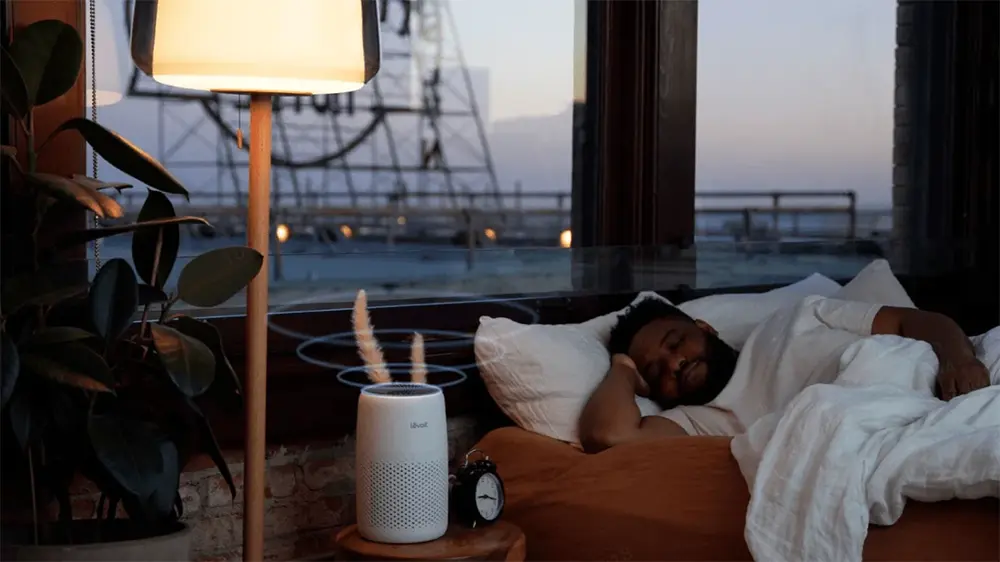
The other half of the problem is the air that accumulates, and the honest way to frame it is as a stand-in for the exchange the room is not getting. In a room that stays closed for hours at a time, an air purifier for the bedroom can help reduce what stays suspended through the night, since it works on the air the room already has rather than on the person in the bed.
Two things matter more than anything else for one in a bedroom. It wants to be matched to the room rather than to the house, because a bedroom is small and an oversized unit mostly buys noise. And it needs to be able to run for long stretches without becoming irritating, because time is the whole advantage.
Two Appliances in a Room That Fits One More Thing
Here is where a small bedroom gets awkward, and it is the part that does not show up in product photos.
Both of these are objects. They take up floor, they are visible from the bed, and they need a wall behind them. In a room that already holds a bed, two nightstands, and a dresser, that is a real constraint rather than a detail.
A few things make it easier.
Height helps here. A tower fan uses a narrow footprint and claims the air above it, so it can live in the gap between furniture that nothing else fits into. A purifier needs clearance around it to work the way it is meant to, so the corner behind the bedroom door, or the stretch of wall beside the closet, tends to suit it better than the middle of the room.
Put them where they do not fight the layout. The fan wants to be somewhere its airflow reaches the bed without sitting directly in your line of sight from the pillow. The purifier wants to be somewhere you can forget about it, because a device you have to step over is one that gets unplugged by the second week.
And wherever they end up, keep the cords where a foot is unlikely to find them in the dark.
Where They Overlap, and What Neither One Does
It would be tidy to say one of these moves air and the other cleans it. Reality is a little looser than that. A purifier does move some air as it works, and a fan does stir up what has already settled. They are two tools with overlapping abilities, each one better at a different part of the same night.
What neither does is replace the room’s ventilation or your cleaning.
If your window opens, use it. A short cross-draft before bed is the cheapest useful thing you can do for a sealed room. The catch is that it only works while it happens, which makes it a habit rather than a fix.
And keep the routine parts in the routine. Washing bedding on a normal schedule, vacuuming rather than sweeping, wiping the tops of things you can see from the bed. None of that is glamorous, and all of it decides how much there is for a purifier to catch in the first place.
One more boundary worth stating plainly: a purifier is not a way to add scent to a room. That is a different job with a different device, and filtration does not do it.
The Door Is Still the Biggest Variable
Before you spend anything, notice what the door does.
A bedroom door left open through the evening gets some of the exchange a closed one goes without. A ceiling fan moves air through the whole room rather than at any one spot. A window cracked before bed resets the room in minutes.
None of that replaces the two devices, and the two devices do not replace any of it. What it means is that the same bedroom can need a different amount of help depending on how the rest of the house is running that week.
Common Questions
Do I need both a fan and a purifier in a bedroom?
Not automatically. They solve two separate things, and you may only have one of them. If the room feels still and warm and you notice it across your face at night, that is the motion problem. If what bothers you is the sense that a closed room keeps everything it started with, that is the other one. Your bedroom may well end up wanting both, but that should be a conclusion rather than a starting point.
Does moving air actually make a room cooler?
No, and it is worth knowing that before you buy anything. A fan does not lower the temperature of a room. What it does is move air across your skin, which is what makes a still room comfortable enough to sleep in. The thermometer does not care. You do.
Will a tower fan help with the dust in a bedroom?
It can make it more noticeable rather than less, because moving air keeps particles suspended instead of letting them settle. That is not a reason to skip the fan. It is a reason to treat filtration and cleaning as separate jobs from keeping the room comfortable.
Can a purifier replace opening the window?
It is not a substitute for ventilation, and it is not meant to be. A purifier works on the air that is already in the room. It cannot add fresh air to it. In a bedroom with a window you can open, the window is still the better tool for the air itself, and the purifier picks up what a window does not cover.
How long should a bedroom purifier run?
Long enough to suit the room rather than the hour. The advantage of a purifier is that it keeps working on a room that keeps being closed, so short bursts are less useful than steady, quiet running. Follow the manufacturer’s guidance for the model and the room size rather than a general rule.
A Closed Room, Night After Night
A bedroom is the hardest room in a house to keep right, because it is the one where you do nothing and let it be closed.
The air that has gone still is the half you can feel, and it is the easy half to solve. The air that never leaves is the half you cannot feel, and it is the one that gets forgotten. Neither is complicated once you stop treating them as a single problem.
Open the door when you can. Move the air where you sleep. Clean the room you keep. And let something run quietly in the corner for the share of it that passes unnoticed.