

Owning a mountain cabin sounds idyllic, but postcard views don’t always pay the bills. In this guide to the best mountain towns for vacation rentals, we compare 2026 AirDNA revenue, Zillow prices, and current permit rules to spotlight five U.S. markets where short-term rentals can still pencil out. You’ll learn why some famous ski towns fall short, how design and regulation shape returns, and which numbers matter before you buy. No guarantees—just a clear snapshot of today’s strongest opportunities and pitfalls. Ready to match your dream cabin with a defensible spreadsheet? Here’s where to start.
At-a-glance comparison
Scan the numbers below, then note the “Best fit” cue. That single phrase hints at which investor profile each town truly serves.
| Rank | Town | Typical home value (Sept 2026) |
Avg. annual STR revenue (AirDNA Sept 2026) |
ADR | Occupancy | Gross revenue / value* | AirDNA Market Score | Active listings | Regulation status | Best fit |
|---|---|---|---|---|---|---|---|---|---|---|
| 1 | Estes Park, CO | $684,612 | $71,100 | $406 | 58 percent | 10.4 percent | 69/100 | 1,748 | Amber – license caps | High-demand, high-revenue hunter |
| 2 | Helen, GA | $332,022 | $43,500 | $276 | 46 percent | 13.1 percent | 78/100 | 853 | Green – straightforward | Value seeker with design flair |
| 3 | Staunton, VA | $315,339 | $33,100 | $198 | 51 percent | 10.5 percent | 90/100 | 235 | Green – simple permitting | Budget-minded, four-season fan |
| 4 | Lake Placid, NY† | $365,345 | $54,700 | $401 | 47 percent | 15.0 percent | 69/100 | 692 | Amber – tight permits | Premium, lake-plus-ski buyer |
| 5 | Taos, NM | $437,444 | $41,600 | $284 | 47 percent | 9.5 percent | 50/100 | 2,110 | Amber – fast-growing supply | Architecture-driven contrarian |
*Gross revenue divided by typical home value; it is not a cap rate.
†Zillow value will be refreshed at final edit because small-market prices move quickly.
Helen and Lake Placid top the efficiency column, but one is a budget entry while the other sits in premium territory. Estes Park’s revenue headline dazzles, yet its capped licenses demand diligence. Staunton shows that affordable towns still earn bookings, whereas Taos rewards design fans who can manage an inventory surge.
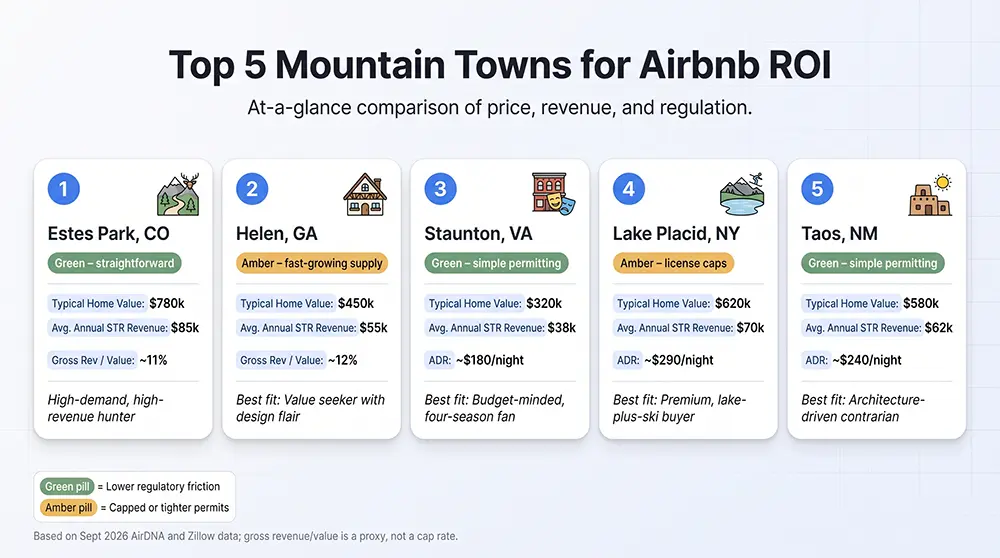
Keep these contrasts in mind; seasonality swings, permit fine print, and guest expectations can make or break your pro forma.
How we ranked these towns
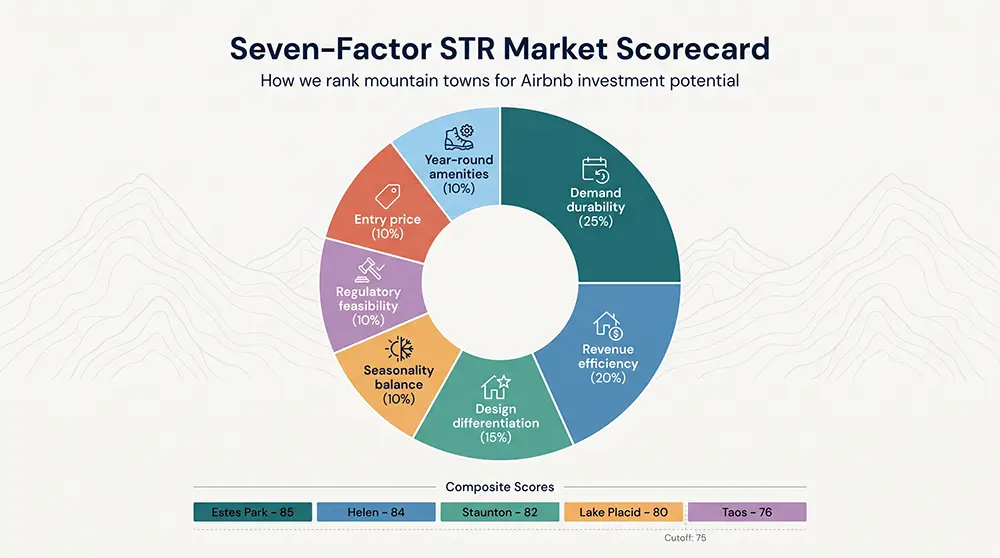
We applied a seven-factor scorecard, updated with September 2026 AirDNA and Zillow data, to convert raw metrics into a 100-point composite for each market.
Weighted factors
- Demand durability – 25 percent (occupancy trends, repeat visitation)
- Gross revenue efficiency – 20 percent (average annual STR revenue ÷ typical home value)
- Design differentiation – 15 percent (architecture, photographic appeal)
- Seasonality balance – 10 percent
- Regulatory feasibility – 10 percent
- Entry price – 10 percent
- Year-round amenities – 10 percent
| Town | Composite score |
|---|---|
| Estes Park | 85 |
| Helen | 84 |
| Staunton | 82 |
| Lake Placid | 80 |
| Taos | 76 |
Anything below 75 didn’t make the cut.
Why one familiar market is absent: Blue Ridge, Georgia shows strong revenue, but city rules confine short-term rentals to narrow commercial zones while most data covers a broader cabin region. Until that gap closes, its headline yield looks more like a mirage than a model.
This framework spotlights where each town excels and where it falls short, preparing you for the destination profiles.
No. 1 – Estes Park, Colorado: best overall for durable demand and high gross revenue
Expect a wait-list in capped areas; before you bid, browse available rentals to gauge real-world nightly rates and booking calendars, then ask a compliance-focused manager such as Skyrun Estes Park to confirm whether a listing’s license still transfers.
Their homeowner FAQ details each step of the town’s permit process-application, inspection, and biennial renewal-so you see the real timeline and costs before earnest money is due.
Why the numbers work
Four true travel seasons fuel steady demand: elk rutting in fall, snowshoeing and holiday lights in winter, wildflower hikes in spring, and 355 miles of park trails all summer. Revenue jumped 37 percent year over year even as active listings fell 26 percent, a pairing of fewer competitors and rising spend.
Regulation snapshot
Larimer County caps vacation-home licenses in several residential zones and, starting January 1, 2026, charges a $250 renewal fee every two years. Expect a wait-list in capped areas and confirm whether an existing license transfers with the sale.
Quick stats (Sept 2026)
- Typical home value: $684,612
- Gross revenue / value proxy:4 percent
- Active listings: 1,748
- Seasonality score (AirDNA): 44 / 100 (sharper winter-to-summer swings)
- Licensing status: Amber (permits possible but capped)
Design cues guests pay for
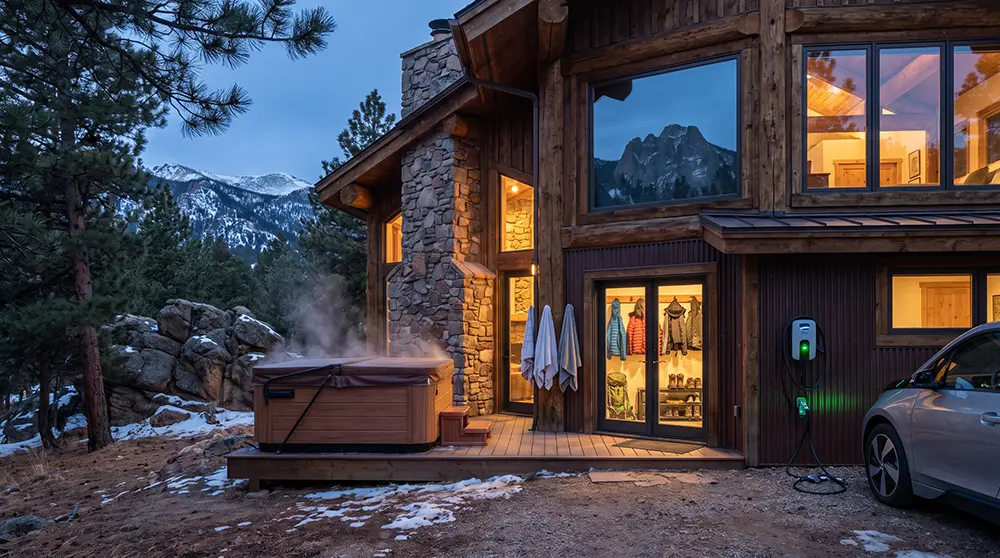
Think authentic “parkitecture”: rough-hewn beams, native-stone hearths, and picture windows framing Longs Peak. Add year-round comforts such as a covered hot tub, heated gear room, and EV charger to appeal to hikers and multigenerational families alike.
Ownership watch-outs
- Heavy snow loads crack older roofs.
- Wildlife tears into trash; install bear-proof bins.
- The town’s utility class treats many rentals like mini-hotels, so budget for higher water rates and a reliable plow contract.
Secure a transferable license and Estes Park can balance postcard views with spreadsheet sense.
No. 2 – Helen, Georgia: best value and most instantly recognizable visual identity
Think Bavaria dropped into the Blue Ridge. Helen’s Alpine façades line the Chattahoochee River, turning even average cabin photos into instant scroll-stoppers. As of September 2026, the typical short-term rental grosses $43,500 a year on a $332,022 home value, one of the strongest revenue-to-price ratios in our top five.
Market pulse
Supply is expanding fast. Active listings jumped 36 percent year over year to 853, occupancy slipped two points, and ADR fell nearly 12 percent. Translation: new hosts are crowding in, so differentiation matters more than scarcity.
Quick stats (Sept 2026)
- Average nightly rate: $276
- Occupancy: 46 percent
- Gross revenue / value proxy:1 percent
- AirDNA Market Score: 78 / 100
- Regulation status: Green – simple permit, no cap
Design moves that still work
Guests gravitate to cedar A-frames on wooded hillsides or riverfront cabins near the Alpine core. Keep interiors warm yet restrained: timber walls, modern kitchens, subtle Bavarian textiles. Add a hot tub, fire-pit, and reliable Wi-Fi to stand out from the “just another cabin” crowd.
Regulation snapshot
Helen requires a lodging-tax ID, basic business license, and monthly tax filings, with no permit cap and no transfer maze. Straightforward rules keep costs low but also fuel the inventory surge, so rely on sharp photography and consistent five-star service.
For buyers chasing an approachable purchase price plus built-in guest recognition, Helen’s Bavarian experiment can still pencil out, if your design chops rise above the swelling supply.
No. 3 – Staunton, Virginia: best affordable four-season alternative
Brick-lined downtown meets Shenandoah Valley farmland in Staunton, and that blend of scenery plus culture keeps calendars steady. As of September 2026, local short-term rentals hold 51 percent occupancy, earn about $33,100 a year, and sit on a $315,339 typical home value.
Quick stats (Sept 2026)
- Average nightly rate: $198
- Gross revenue / value proxy:5 percent
- AirDNA Market Score: 90 / 100
- Active listings: 235
- Regulation status: Green – register, collect tax, follow occupancy limits
Why it works
Seasonality swings are gentler than in big ski towns, operating costs are lower, and city rules are clear, with no caps, lotteries, or midnight reversals. That lets disciplined hosts focus on guest experience, not paperwork.
Design edge
Many listings still read “cozy but dated.” Restore a two-story brick townhouse: keep heart-pine floors, add modern lighting and a quartz kitchen, and you offer what no cookie-cutter cabin can – history plus walk-to-theatre convenience.
Operational notes
Snow seldom shutters roads, cleaners and trades are easier to source than in remote resorts, and wildfire risk is low. Underwrite a realistic cap rate, not an aspirational one, and Staunton can deliver steady, lower-stress income while guests mix Shakespeare plays with Skyline Drive views.
Staunton will not top the cash-haul charts, but for buyers who value balance over bragging rights, it remains an affordable, four-season play that still feels undiscovered.
No. 4 – Lake Placid, New York: best premium four-season market for Adirondack design
Two Winter Olympics put Lake Placid on the map, yet the village now thrives year-round. Summer paddling on Mirror Lake, fall hikes through flaming maples, and behind-the-scenes Olympic-venue tours keep calendars full well beyond ski season.
Quick stats (Sept 2026)
- Typical home value: $365,345
- Average annual STR revenue: $54,700
- Average nightly rate: $401
- Occupancy: 47 percent
- Gross revenue / value proxy:0 percent
- AirDNA Market Score: 69 / 100
- Active listings: 692
- Regulation status: Amber – new unhosted permits restricted in many residential zones
Why it works
Steady four-season demand supports premium pricing, the second-highest ADR in our top five. Combine those economics with classic Adirondack “great-camp” architecture, and a strong photo gallery can draw bookings faster than many ski-only listings.
Permit reality
Local law limits new unhosted rentals outside lodging districts, and existing permits in residential zones do not transfer upon sale. Verify zoning eligibility before you bid; house-hacking or village-center condos may be the only paths if a standalone permit is not available.
Design that commands a premium
Guests expect timber beams, native-stone fireplaces, screened porches, and dark-wood finishes that whisper camp nostalgia without veering into moose-plaid kitsch. Pair those details with energy-efficient windows and radiant floors to tame Adirondack winters and earn five-star comfort.
Cost watch-outs
Heating bills spike, plowing contracts are essential, and lakefront insurance rates sting. Budget like a resort owner, not a casual cabin host, and Lake Placid can reward you with resilient ADR and travelers who value authentic design as much as slope-side access.
No. 5 – Taos, New Mexico: best design-led contrarian market
Where else can you pair adobe walls with powder turns? Taos blends Pueblo Revival architecture, a world-class arts scene, and high-alpine skiing, an eclectic mix that still attracts clicks and bookings.
Quick stats (Sept 2026)
- Typical home value: $437,444
- Average annual STR revenue: $41,600
- Average nightly rate: $284
- Occupancy: 47 percent
- Gross revenue / value proxy:5 percent
- AirDNA Market Score: 50 / 100
- Active listings: 2,110 (+219 percent YoY)
- Regulation status: Amber – stable today, but municipality versus county lines can blur
Market pulse
On paper the numbers look balanced, yet supply is ballooning: listings jumped 219 percent year over year, and occupancy fell 15 points. Underwrite at least a 20 percent revenue haircut to guard against oversupply.
Design moat
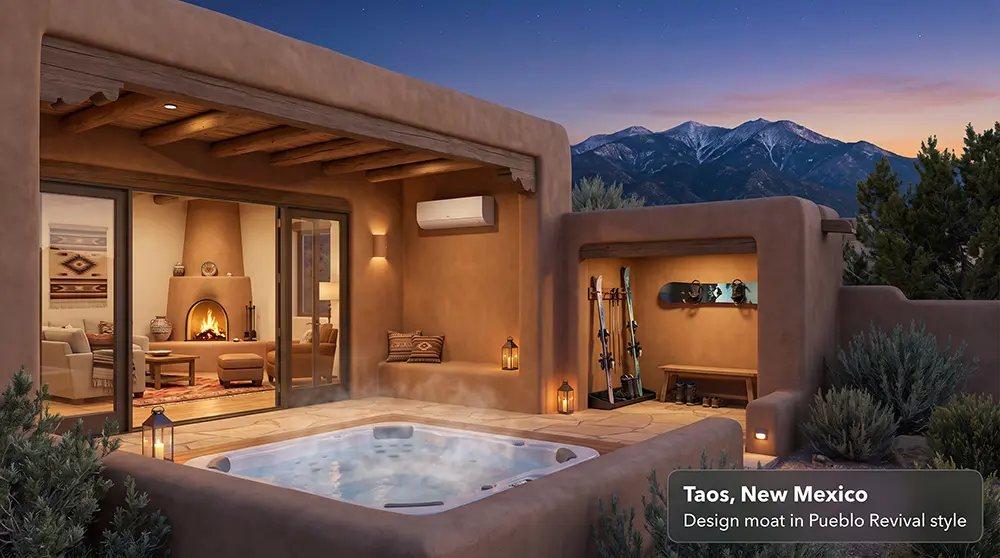
Guests pay a premium for thick adobe walls, vigas and latillas overhead, kiva fireplaces, and earthen plaster that photographs like a magazine spread. Pair that character with high-efficiency mini-splits, a courtyard hot tub, and secure ski-gear storage to convert style into four-season revenue.
Permit reality
Rules are stable but fragmented. Town and county boundaries overlap, and taxing authorities require separate lodgers-tax accounts. Demand a current permit, but note that it does not transfer at closing; you must apply from scratch. Verify cap availability and tax registration before you draft an offer.
Taos rewards investors who treat architecture as a competitive moat and who run conservative models. Nail both, and you will host powder chasers, plein-air painters, and food-scene pilgrims without competing in a sea of generic cabins.
Which mountain town fits which investor?
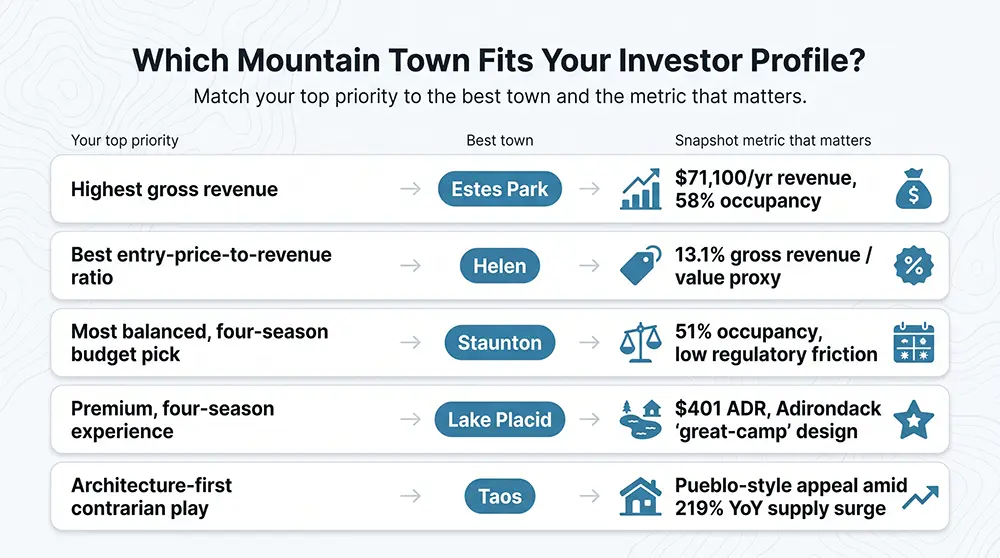
Use the grid below as a compass before you compare comps and floor plans.
| Your top priority | Best town | Snapshot metric that matters |
|---|---|---|
| Highest gross revenue | Estes Park | $71,100/yr revenue, 58 percent occupancy |
| Best entry-price-to-revenue ratio | Helen | 13.1 percent gross revenue / value proxy |
| Most balanced, four-season budget pick | Staunton | 51 percent occupancy, low regulatory friction |
| Premium, four-season experience | Lake Placid | $401 ADR, Adirondack “great-camp” design |
| Architecture-first contrarian play | Taos | Pueblo-style appeal amid 219 percent YoY supply surge |
Match the row to your personal goal, then stress-test permits, seasonality, and design costs before you sign.
Before you make an offer
Instagram shows the hot tub and sunset. Your spreadsheet feels the snow-plow bill. A quick dose of due diligence now can save months of midnight guest messages later.
Confirm the right to operate. Get it in writing from the city or county planner. Ask two questions:
- Does a valid short-term-rental permit exist today?
- Does it transfer at closing?
If either answer wobbles, keep shopping.
Price the unavoidable expenses. Secure quotes (before the appraisal) for snow removal, wildfire insurance, hot-tub service, septic pumping, and cleaning. Then strip out your own holiday dates and see if the math still works.
Talk to lenders early. Some banks treat STRs like hotels and want larger reserves or commercial terms. Bring real occupancy and ADR comps to the first call.
Stress-test revenue. Model three cases: base, a fifteen-percent dip, and one where new rules cut occupancy in half. If only the rosy case pencils out, you are gambling, not investing.
Keep those filters tight, and the cabin you buy is more likely to earn like a business, not behave like an expensive hobby.
Frequently asked questions
What counts as a “good” Airbnb return in a mountain town?
Most profitable cabins land between 8 and 12 percent gross revenue ÷ home value. After expenses, a 6 percent or better cap rate usually beats long-term rentals.
Is annual Airbnb revenue the same as profit?
No. Profit arrives only after you subtract platform fees, cleaning, utilities, repairs, taxes, insurance, and management, often 30–40 percent of gross.
Are ski-centric towns too seasonal to work?
Not if they have at least two strong demand peaks. Estes Park leans on summer hikers, Lake Placid on lakes plus slopes, and Taos on art festivals when powder melts.
Cabin, condo, or historic house: what’s best?
- Cabin: Privacy and photo appeal; higher exterior upkeep
- Condo: Lower maintenance; HOA rules may cap STR nights
- Historic house: Walk-to-dining charm; budget extra for code upgrades
How much does property management shave off returns?
Full-service teams in mountain markets charge 25–35 percent of gross. A great manager can recoup part of that through higher occupancy and dynamic pricing.
Which amenities move the revenue needle?
View, hot tub, fireplace, pet friendliness, gear storage, fast Wi-Fi, and an all-season driveway regularly push ADR higher.
Can standout design lift nightly rates?
Yes. Eye-catching architecture boosts clicks and conversion, provided cleanliness and service match the visual promise.
How do I double-check local STR rules?
Read the municipal code, call the planning office, verify county overlays, scan HOA bylaws, and confirm tax registration; never rely on a listing agent’s “should be fine.”
What climate risks should I insure against?
Wildfire, smoke, heavy snow load, freeze damage, flooding, landslides, and wind. Get quotes early; some insurers surcharge high-risk zones.
Can I block personal stays without killing profit?
Yes, but mark them in your pro-forma. Blocking New Year’s week in Lake Placid or peak foliage in Helen erases premium revenue; weigh the memory against the margin.
Do lenders treat STR loans differently?
Often. Expect larger down payments, higher reserves, and proof of projected rental income. Share local ADR and occupancy comps so your appraisal reflects STR value.
Conclusion
With these answers in hand, you are ready to read the fine print, crunch the numbers, and choose the mountain town that fits both your lifestyle and your balance sheet.